
Basics of Artificial Intelligence
What is AI?
Artificial intelligence, or AI, refers to computer systems designed to perform tasks that typically require human intelligence. Things like recognizing patterns, understanding language, and solving problems. While ChatGPT’s launch in 2022 brought AI into the mainstream, we’ve actually been relying on AI for years. Amazon Alexa, predictive text on smartphones, and social media algorithms are just a few examples of AI we interact with daily. In fact, versions of AI have been around since the mid-1950s, and they’ve evolved dramatically over the years.
Modern AI relies heavily on a technique called machine learning, where the AI system learns patterns from vast amounts of training data rather than being explicitly programmed with rules. Imagine teaching a child to recognize animals: instead of giving them a detailed list of traits that define a dog or cat, you simply show them many pictures. Over time, they start to recognize which animals are dogs and which are cats without ever needing a formal definition. Machine learning works similarly, but it requires far more training data. By studying millions or even billions of examples, AI systems learn patterns and relationships, allowing them to make predictions or generate new content based on what they’ve seen before.
Generative AI
Generative AI is the type of AI that exploded in late 2022 after the release of ChatGPT. Generative AI tools like ChatGPT are also known as Large Language Models (LLMs for short) because they specialize in generating human language. For simplicity, I will drop the “generative” and refer to this technology as “AI” for the rest of this course. As described in the figure below, the user simply inputs a prompt in plain language into the AI tool, the AI tool quickly processes the prompt, and it outputs the desired content.
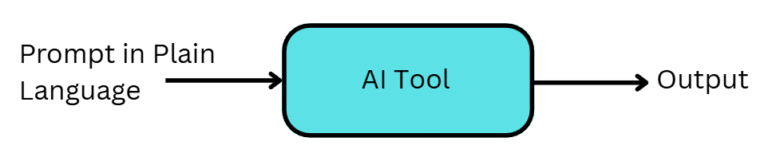
What makes this technology feel so different is how naturally you can communicate with it. Instead of using code, you simply type or speak in plain language and the AI responds like a conversation partner. After it responds, you can ask it to explain, rephrase, or refine its answers, and it will adapt based on your feedback. The interaction is similar to a back-and-forth conversation you’d have with a human, where the AI remembers context and adjusts its tone or level of detail based on your desires. This conversational ability and flexibility is what makes AI tools so accessible and powerful for everyday use.
Think of AI as a very smart assistant that can help you write, brainstorm, solve problems, or conduct research with minimal effort. The key word is assistant. AI should act as your copilot, not the pilot. Many people approach AI expecting flawless execution on every task. And when it sometimes falls short, they dismiss it as overhyped and avoid AI entirely. This is a mistake. The real power of AI isn’t in perfection, it’s in improvement. AI won’t handle 100% of every task, and that’s okay. Depending on what you’re doing, it might take on 20% of the work, 50%, or even 90%. Sometimes it’ll completely miss the mark and contribute nothing. But even partial help leads to meaningful productivity gains. When used consistently, those small productivity boosts compound over time, just like consistently investing small amounts in the stock market can eventually make you a millionaire.
Model Training
Training AI models involves feeding them enormous amounts of text, images, and other data so they can learn relationships between the data. Instead of memorizing facts, the model adjusts billions of internal parameters to predict the next word in a sequence, gradually learning structure, logic, and nuance. The scale of AI training is staggering. Modern systems like ChatGPT are trained on hundreds of billions to trillions of words drawn from the internet, books, and other digital sources. This vast exposure allows the model to generalize patterns across nearly every topic humans write about, enabling it to generate coherent responses.
However, AI models don’t truly understand the world. They recognize patterns based on what they’ve seen during training. If you show a child who has never seen a zebra a picture of a zebra, they might confidently (but incorrectly) identify it as a horse. Similarly, if you ask an AI model a question that wasn’t in its training data, it will try to fill in the gaps by generating the most plausible (but incorrect) answer. This phenomenon is known as hallucinating. It’s silly to blame the child or the AI model in either scenario because they were never taught this information to begin with. Since AI’s goal is to produce coherent text rather than verify facts, you should expect it to sometimes provide incorrect answers with confidence. This makes human judgment and fact-checking essential when using AI.
To understand more about how AI models are trained, visit this site.
Using AI: Real World Example
Let’s say I’d like to plan a tropical vacation but I’m having trouble thinking of a location. I can open my favorite AI tool and type in the following:
“Suppose you are an experienced travel advisor. Suggest 5 tropical vacation destinations for my wife and I to enjoy a 5 day vacation. The locations should offer plenty of beautiful beaches, mountains, adventurous hikes, unique food, must be within a 6 hour flight of Chicago IL, and not be overly touristy. Total cost of the trip should not be more than $1,700.”
Note a couple of key elements of this prompt: it’s highly descriptive and specific. This is completely different from a typical Google search, which is high level and only contains a handful of keywords. We didn’t just mention a tropical vacation – we specified many other relevant details:
- How long we’d be there
- That it’s only my wife and I
- Must haves: beautiful beaches, mountains, adventurous hikes, unique food, within a 6 hour flight of Chicago
- Must avoid: overly touristy, total cost > $1,700.
This brings us to a key lesson: AI’s strength lies in its ability to understand complex, nuanced requests and provide personalized responses. Traditional search engines simply aren’t designed to do this. Conversely, the best AI users are skilled communicators – they can translate complex ideas into simple, well-structured prompts. We’ll learn all the tips to communicate effectively with AI in the next section.
Difference between AI and Search Engines
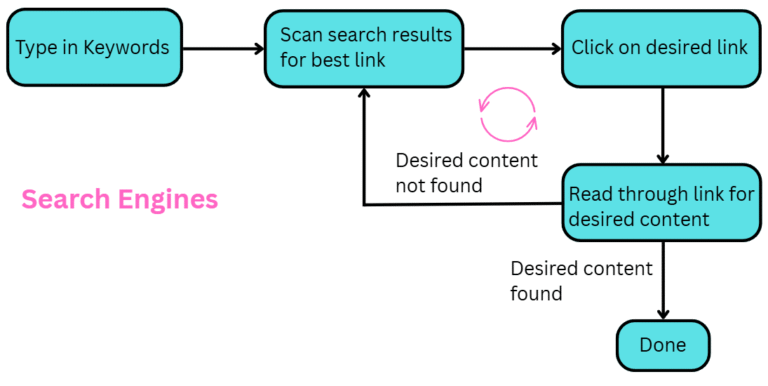
Let’s briefly consider how to accomplish the same vacation task using a search engine like Google, illustrated in the diagram below. First, typing a wordy prompt such as the one above into Google would yield poor results as it would confuse the search engine. Since search engines are designed for users to enter only a handful of keywords, we’re constrained to a prompt such as “best tropical vacation destinations” if we want halfway decent results. Then we’ll click through a handful of links and read through them until we’ve selected a place that meets all of our criteria. After we’ve finished, we might’ve read through 5 articles and wasted 30 minutes or more. This was revolutionary when the internet first appeared in the early 2000s, but now inefficient thanks to AI.
This is not to say that we should ditch search engines completely and only rely on AI tools. AI is not a cure-all technology, and I’d encourage you to be cautious of those who claim otherwise. There are plenty of instances where choosing a search engine over AI is still preferred:
- you need verified information from trusted sources (AI will sometimes hallucinate)
- you’re looking for up-to-date or real time information/data (AI tools often have knowledge cutoff dates, sometimes several years into the past)
- you need to access specific websites, databases, or online services directly
- you’re researching topics where precision and academic rigor are absolutely essential
- when using AI will take longer.
We’ll cover these topics in more detail in the Limitations of AI section.
Now that you have a feel for what a good AI prompt looks like, try to think of a few additional ways you could use AI in your career and/or personal life along with associated prompts. Maybe you need recipe suggestions for the ingredients you have on-hand, a few ways to invest $5,000 given your risk tolerance and financial goals, or help drafting the script for a YouTube video. Type your prompts into an AI tool and review the results. Next we’ll dive deeper into how to write effective AI prompts.